
‘Before you go on, I want to interrupt you for a moment, because otherwise you might miss it,’ said my tutor, Peter van der Graaf, stopping me in the middle of my story. ‘Have a look at the non-verbal language of your fellow students. What do you see?’ Still half floating in the process I was describing, I moved my gaze from one screen to the other, with the little rectangles in which I saw my fellow students smiling, chuckling and even laughing. I needed a moment to get my bearings and understand what was happening.
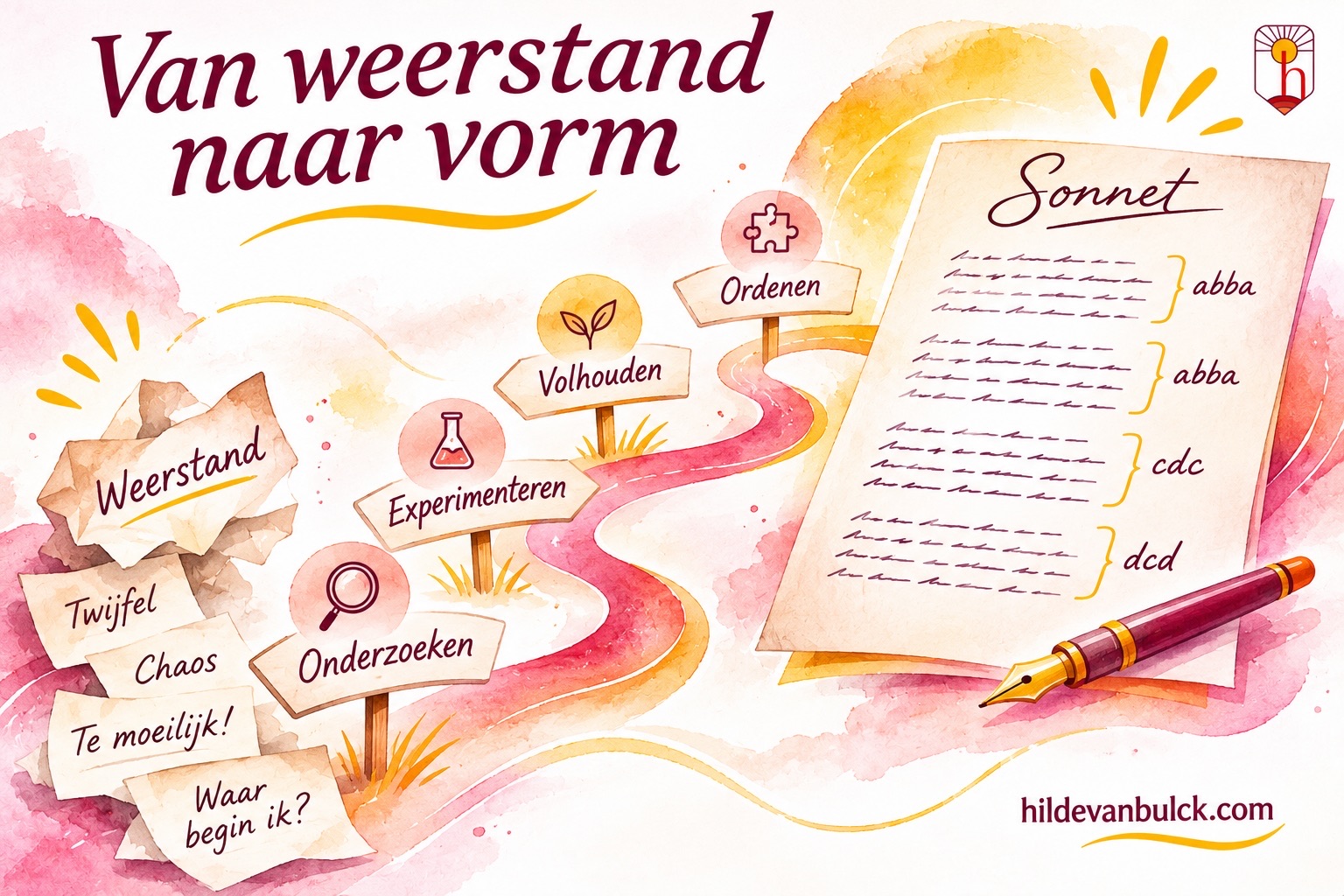
Three weeks earlier, as after every lesson, we had been given a homework assignment in the Literary Writing course: write a sonnet with the rhyme scheme abba – abba – cdc – dcd. That one short sentence was all it took to set off my resistance.
As if a time machine had flung me back to my student days, I was once again right in the middle of my aversion to poetry. Not that I have anything against poems. As long as I don’t have to analyse them. Ever since I was about ten, I have loved reading. I would even say it is my first and longest-lasting love. And so I have eagerly devoured a great deal of fiction and non-fiction. Until, at secondary school and during my teacher training, something got disrupted.
Why does the writer or poet use this word? This figure of speech? This rhyme scheme? What does he mean by it? My main reaction was invariably: how am I supposed to know that? Wouldn’t it be better to ask the writer? That, of course, was impossible for works from bygone days. To cut a long story short: it was a struggle back then. I couldn’t even keep my attention on it for more than two or three sentences. I lost the theme of the poem. My brain crackled in every direction. It went into time-out while I tried in vain to fish it back. Beads of sweat literally appeared on my hands as I ploughed through exams like that. That is when my resistance to analysing literature and poetry took root.
One person had noticed my struggle: my French literature teacher during my teacher training. He spoke to me: ‘You are a very sensitive person. You can tap into deeper layers. You reflect and you can touch the essence. And yet it’s as if you can’t deal with poems. I don’t quite understand that.’ He looked at me. I glanced aside a little shyly, surprised at how he described me. Only the part about the poems was familiar. I had never looked at myself that way in any of the other respects. How I responded back then has vanished into the folds of my life story. But the fact that I was seen at that moment has always stayed with me, and I am grateful for it.
Back to now. During the lesson, we read the sonnets of the other poets. My brain was crackling again. Keep your attention on it. What is the theme? What do you find beautiful? What flows less well? What strikes you here? I was noticeably quiet and listened carefully to the thoughts the others put forward, hoping to gather enough inspiration that way.
It was my turn to read out my sonnet. I was curious about the reactions. It was quiet. Silent as a mouse. I saw appreciative nods in the little rectangles on the screen. Once again the tutor stepped in: ‘Could you tell us something about how you got from your struggle to this result?’ Relieved, I was happy to answer his question. That seemed easier to me than answering why-questions about my sonnet.
Because of the eleventh of November, the Armistice Day holiday, we had three weeks instead of two to hand in our homework. The first week I walked around like an indignant teenager who couldn’t see the point of the assignment. I had no idea how to begin. Then I remembered the promise I had made to myself: in this course, I would embrace every resistance I came across and look for a way to overcome it. That alone was already a victory.
The best thing I could do was immerse myself in existing sonnets. The very idea. Fortunately, a book called out to me from my personal library, with a whole chapter on the sonnet and matching little exercises to then squeeze one out of your own brain. I decided to read it and connect everything in that chapter with what I had learnt in class. I created a file entitled Writing assignment - The sonnet.
For the next step, I went online. At first I had thought of going to the library, but in the end I chose the shortcut. If you type in sonnet, you get nothing but English versions. Searching for Dutch-language ones, I came across examples from literature written long before I was born. I read them. And again. My brain short-circuited once more. Where on earth does my attention keep flying off to? I laid the rhyme scheme next to them, only to find there were many deviations. That didn’t really help my state of mind.
Would there be modern versions too? Oh yes, loads of them, in fact. Would these be easier? Marginally. I copied several and read them over and over. Laid the rhyme scheme next to them again. Deviations again. Were we allowed to deviate too? The tutor had clearly specified abba abba cdc dcd. Still, I grew a little calmer.
I had my theme quickly. I was determined to write about my struggle. I followed the little exercises in the book and wrote a long string of sentences off the cuff. Done in a few minutes. Relief. This was the writing I knew. I showed my list to the figures in the little rectangles, who were following my story attentively. Looking at my sentences with my sonnet in mind, my brain said once again: ‘I’m off for a bit.’
With a yellow highlighter in hand, I marked the words for which I might want to find a rhyme. The tutor had stressed the use of rhyming dictionaries. Relieved, I started putting my words to the one he considered the best. I noted down every rhyme that seemed interesting to me. Yet I found more to my liking in the Van Dale rhyming dictionary, and my long list grew even longer. This gave me a good feeling. As if I was gaining a bit more control. I showed that list, too, to the faces on the screen.
Half enthusiastically, I tried to put together two quatrains and two tercets from my harvest of words. It worked, but to my mind it was all cobbled together. In many cases there is criticism when someone uses ChatGPT, so I wasn’t going to do that. On the other hand, if I knew someone who was skilled at writing poems, I would probably ask them for advice. ChatGPT is a bit like that. I decided to do it after all.
I submitted my attempt with the request to look at it critically and give me feedback as a beginner, the way a good acquaintance would, but not to write a version itself. With a critical yet encouraging voice, as we know it, it looked at the rhyme scheme, the theme, the order, the rhyming words, bombastic language, far-fetched language and things that didn’t fit. Each time I got to work with it, polishing and adjusting without losing my own stubborn streak. I read it aloud to see whether I had caught the rhythm. After the sixth version I said: ‘That’s it now. At some point it can simply be finished, without being perfect. I’m satisfied.’ It took me three weeks. Only on the last day was I able to post it in the homework group.
Meanwhile, I now noticed, I had been busy analysing poetry extensively. What works for me in poetry and what doesn’t? Along the way, I remembered that I had once spontaneously written nine poems, which I published in my first book De nacht van ons leven. Back then I wrote without knowing the rules. Now I was trying to know the rules in order to be able to write.
I am an intuitive writer. I start from a thought, a feeling, an image or an unexpected connection. The words follow automatically, from a natural flow. Gathering ideas comes by itself, the poetic thinking is already there, but the battle begins when I have to march into a form of fourteen little lines. Starting from the form, I searched for my own language and freedom.

Besides the end result, my fellow students found my search hilarious. ‘Incredible how openly and honestly you’ve told this,’ someone said, laughing. Not only had I written a sonnet – something I had never dreamt of – but I had given a little performance of how an intuitive writer’s brain reacts to a rigid straitjacket. The writing tutor highlighted the power of this process as an example for everyone.
It was as if I was being rewarded for the hours I had spent researching, experimenting and writing. A result I had not imagined at any point. With a heart full of bliss, I went into the night.
MY BRAIN DOESN’T RHYME WITH RULES
Reading poems always felt a weight to bear,
I searched for words to charm my heart and mind.
What I read was seldom what I’d find,
as if no verse would ever fit me there.
My French teacher was taken unaware
that I, so sensitive, kept verse smothered and confined.
How could it be that poems and I weren’t aligned?
For years his disbelief held me in its snare.
Now it’s my turn to try a sonnet of my own,
with each new rhyme scheme, sparks crackle through my brain.
Yet clearly there is more here to be known.
For once, just dreaming idly on a train,
I wrote nine, without a lesson, all alone.
They even made it into print, and not in vain.


