
A bench, the spring and an unexpected remark
Sometimes life does not reveal its lessons in the moment of action, but precisely in the stillness in between. On a bench in the spring sunshine I let my eyes wander over nature slowly waking from its winter sleep. Those first days in which everything starts to flow again are blissful. I let time stand still for a moment. Softly, something in me says: ‘Now the new year is really beginning.’ And at exactly that moment, out of nowhere, a sentence drops. One that lingers.
Next to me sits a student. She is almost at the end of an intense two-year training programme that I guide. Only her final assignment is still waiting, her personal work, the crowning piece of the programme. The plank across the pit. For some people the difference between completing something and leaving it unfinished. Then she says without hesitating: ‘I have everything together, but I am not going to write my personal work.’
Her words hang in the air. Not because they are meant dramatically, but because they touch on something bigger: the moment when you decide not to do something.
Just before the finish
It does something to me. I cannot deny that. It always has. The sun lost none of its brightness, the little birds went on chirping and the world simply kept turning. Nothing earth-shattering, then. A pinprick in existence, or perhaps even smaller. In the past I would have felt a stab of pain in my heart, been somewhat irritated, tried to convince the person and insisted on the letter of our agreement. I am past that stage. I stay calm about it. Grounded and well present, even, knowing that techniques of persuasion produce little or no result. It is her choice, not mine. I am not the one who bears the consequences.
About the moment when we have almost finished… and stop anyway.

The brake on the last kilometre
As a trainer of courses and, in the past, as a teacher, the phenomenon of someone stopping just before the finishing line is not unfamiliar to me. It also takes me back to all those times when I used to travel somewhere in the country to carry out an assignment. What happened then can serve here as an illuminating image. I was often held up about a kilometre from my destination. Roads were dug up, there were diversions, events blocking the access, or the sat nav led me to a dead-end forest track. Always those last few steps. Something like panic would come over me. Sometimes I felt like giving up and turning back. Something slowed me down right before the end. And that is exactly what happens to many people. In courses, in exams, in large and small life projects.
It happened so often that I paid attention to ‘the why’ of it. Always those last few hundred metres. It was as if something lay just beyond my reach. The finishing line was almost there for the taking, but I just could not get to it. I was missing a piece of the puzzle. Information that was lacking and that I needed in order to take the last step without obstacles. It made me despondent. I applied this image to a personal theme that was about a deep truth. For me the two were connected. Like a metaphor that encouraged me on the one hand, because I was nearly there, but that on the other hand was exhausting, groping in the dark for the missing piece. As I found more peace in the theme of truth, the literal obstacles on the way to my destination disappeared. There is still an important insight to be integrated before the last step can be taken: a fear that is pulling the strings has to be faced.
Leaving something undone means losing opportunities.
Self-reflection
Even though I stay calm when someone gives up, it does something to me. From the principle of ‘do yourself what you tell others to do’, I turned my gaze inwards to examine what it was that touched me. In a course like that I am one hundred per cent present for my students and their growth. I guide, inspire, motivate and activate them in their process of reaching their highest potential. It drives me to see their process unfold and to see the participants leave stronger than they arrived. Do I expect the same drive from them? Do I have that right? No. I cannot and need not expect the same drive from them. It is an exercise I have become better at over the years.
Confession: I plead guilty
The next day I woke up with a sentence repeating itself in a whisper. There was something in it for me to do. Not only for myself, but also for all those who give up just before the finishing line, or perhaps even earlier. Unasked, my thoughts pushed forward a list of things I have not finished myself. Things I ‘leave lying around’. You trip over them. They are never gone. There is a book, for instance, that I have written three quarters of. It lies slumbering somewhere, haunts the back of your mind and, at the moment you least expect it, suddenly pops up through other people’s questions: ‘Weren’t you going to write a book?’ And yet there are reasons why it is not being finished. Whether those reasons are legitimate is another matter. I use them as if they were legitimate, but inside I know: they have become worthless.
Completing something is the place where strength, self-worth and inner peace come together.
The researcher
When I observed why I did not finish certain opportunities, I ended up with strong feelings of discomfort. An inner unease, a paralysing fear whose origin I did not know in the past. Something that took my breath away. What I did know was that the feeling did everything it could to make me give up at a certain moment.
I am a curious creature and a researcher. I keep searching until I find an answer that satisfies me. And I found the answer… with the pupils.
What happens with pupils also happens with you.
Of course there can be external circumstances holding you back, but in most cases it is about your inner state of being. I was able to observe this very well during my career as a secondary school teacher. What happened with the pupils probably happens with you too. Imagine an exam, something we all know. Even before the exam starts, there are pupils who give up. You see it in their body and their aura, you hear it in what they say even if they do not say it literally. You find it in the lack of depth or in the absence of their commitment during the school year.
What I learned together with my pupils.
I wanted to take every pupil along to a good result because I believed in them, and also because I could see that their potential was greater than they themselves thought possible. How was I to make it clear to them that they must not give up? On the board a drawing appeared that showed what was happening to them just before the exams. It was a simple drawing that came into being in the moment, but one that was worth drawing. The pupils’ morale rose and in most of them a little flame was kindled that made them approach the exams differently. It was a successful initiative and the result was better marks to take home. But far more important was the euphoria afterwards. The good feeling they had and the better self-image they took home with them. A feather in my cap and in theirs!
Completing something is an act of strength.
The deep pit and the narrow plank
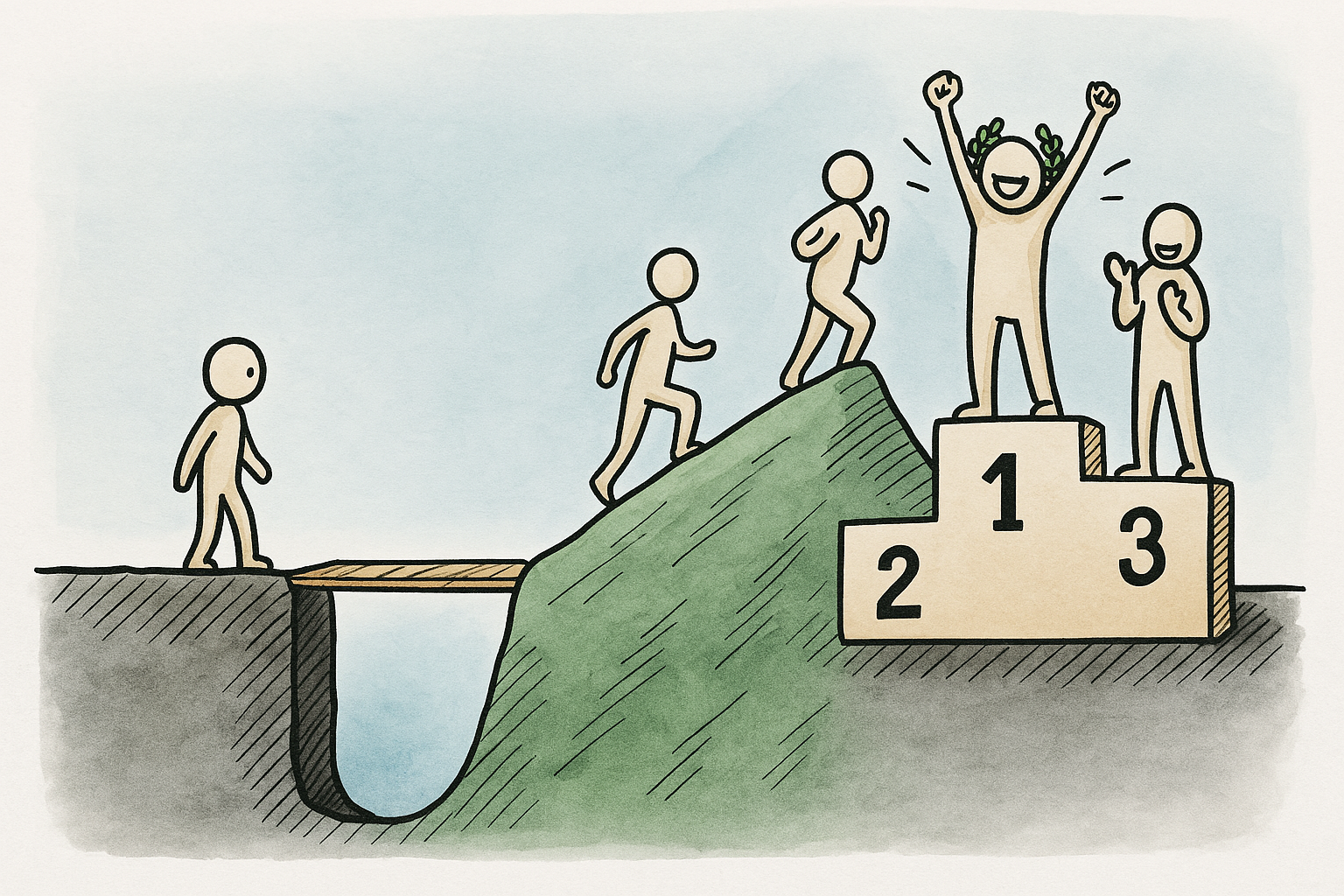
If, as a pupil, you have committed yourself sufficiently during the school year, you will be able to start studying for the exams with a healthy effort. If they had not done so, it was as if they were standing in front of a deep pit even before the start. I drew on the board what I saw: a deep pit. It looked insurmountable. Behind it, the mountain they had to climb to the top. Their courage sank into their boots. They preferred to be flippant about the exams or to adopt an attitude of not being interested. However tough they acted, their self-image takes a blow if they fail or get low marks. In the long run that determines your well-being. What if we were to lay a sturdy plank across the pit? And I drew a plank. The plank stood for the decision not to give up, for the inner moment when you say: ‘I am going to do it after all.’ At that point the worst is actually already over. Then the climb to the top of the mountain begins. When the pupils looked at the top, they were inclined to give up again. I encouraged them to take one step at a time. To read the first page. I drew the step. And only then to go on to the next step, not a sprint. When you go walking in the mountains, the summit sometimes disappears behind the trees as well. At every step they reward themselves with a pat on the back for that small success. When they look back, they see the road they have already covered. That is no small thing. With every step the goal comes closer. Enjoy the journey. Leave nothing undone, but carry on. At the top the exciting exam is waiting, which is less nerve-racking than usual because the preparatory steps have been taken. After the effort comes the relaxation, and in the drawing we see the pupils joyfully going down the slope on the other side of the mountain. And then comes the ultimate reward. The podium of results and self-worth. The pupils drew themselves on the podium with a trophy or a laurel wreath around their head. By completing something, everything is tidied up neatly. No loose ends are left dangling.
Why do you stop before the finishing line?
Resistance just before the finishing line is a well-known phenomenon in personal development as well as at a systemic level.
Often what is at play is:
- Fear of change: if you finish something, it means that something really has changed.
- Doubt about your self-worth and self-image: ‘I am someone who does not finish things’ feels safer than ‘I am someone who finishes things and therefore really becomes visible’.
- Fear of success: if you show that you can do it, you have to live up to it as well. What then?
- Loyalty to (someone in) the family system where ‘not finishing things’ was the norm.
You leave something undone because completing it means change.
A systemic exercise for completion: are you putting the roof on your house?
- Write down three things you have started but not completed.
- Choose one of them. Sit with it for a while and ask yourself the following questions:
- What makes me not complete this (yet)?
- What could happen if I did complete it?
- Who in my family system was unable to complete something, or found it hard to complete things?
- Who or what am I trying to stay loyal to by not finishing it?
- Then imagine that you do finish it after all. How does it feel? What changes?
- Close with a small first action. (a phone call, writing a page, opening a folder).
The finishing line is within reach. Take that one step.

Finally: no sensible person leaves their roof unfinished
No sensible person would think of leaving the roof of their house unfinished. Why would you fail to finish a house, in the form of a project you have worked on for a long time, at the very last moment? You know that finishing it will give you a feeling of pride and satisfaction. You know that only then is something truly complete. Because whatever you leave lying around will one day lie in your way. It is a pattern you will most certainly find in other areas of your life as well. Many loose ends eventually form an insurmountable mountain.
Hilde Van Bulck
More information about my work and what I offer: www.hildevanbulck.com
Hilde guides people in systemic and energetic work, with years of experience in education, constellation work and presence consciousness. She helps leaders and their teams to turn problem situations into opportunities for growth. She gives training courses, guides people in their personal and professional development and writes about the richness of life, including its paradoxes.