
I used to think there were many different problems. After more than twenty years of working with clients and students, I came to see it differently within a few years. You could trace most of the problems people struggle with inside themselves back to one big underlying problem, from which all the others derive. People are often cut off from themselves; they have lost the connection, and their anchoring in the NOW no longer exists. They wander around in a world of memories, of old situations and events that seem so real they become their absolute reality. They have lost their way in the past. In this article, I mainly want to look at this phenomenon from different angles and shed light on it, rather than work out the solution. That is material for another article. Still, at the end I will give you a few basic steps to help you learn how to move from the past into the present.
Pushed by the past and pulled by the future
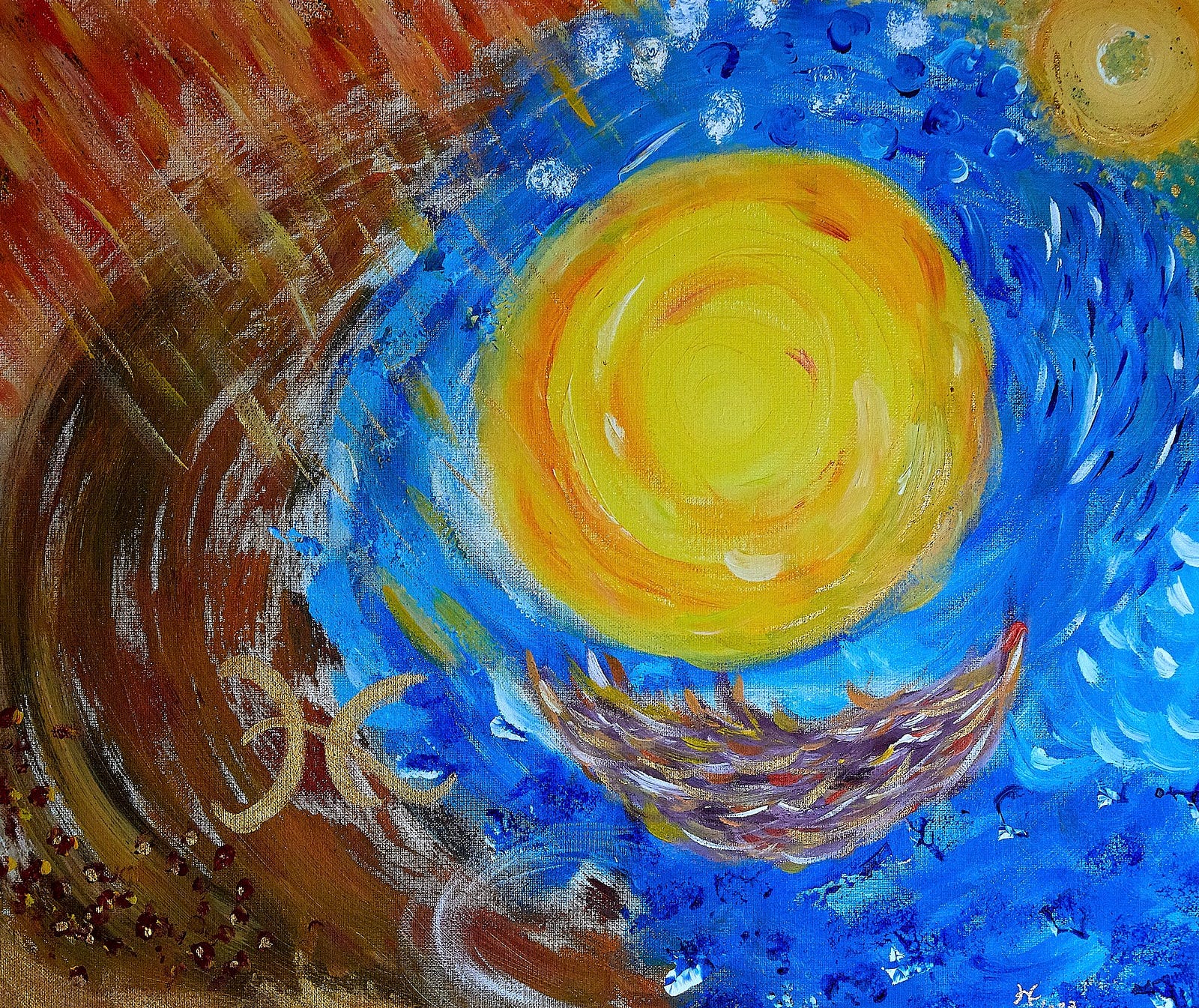
Years ago, before I knew anything about painting techniques, I painted a canvas on the theme: pushed by the past and pulled by the future. I only gave it its title afterwards, as I had no particular intention but gave my brushes complete freedom to create whatever they wanted. As an Awareness Architect, I welcome clients who come to me to live their lives in a more conscious way. I found the painting interesting because I could use it in sessions with clients who remained stuck in stubborn patterns. One feature of such patterns is that your presence unconsciously travels back and forth between the past and the future, so that you miss the present moment completely and your pattern never gets resolved. The painting made something clear. It brought clarity to something that is not always easy to put into words. The energy of the painting touched their emotions. So many years later, I would portray the balance between the pushing force of the past and the pulling force of the future differently, but at the time the painting served its purpose.
We suffer from rear-view mirror syndrome
No doubt you have sometimes got up in the morning while holding conversations in your head with people who played a part in a situation that took place yesterday, or even long ago. Perhaps you notice that your peace of mind changes and that it affects your mood or your vitality. It may well be that you hold conversations with yourself as if you were on a roundabout, going round the same circle again and again. How many times have you already driven round that roundabout? How many years have you been doing it? You are looking in the rear-view mirror.
No doubt you have at some point asked your father why he still does certain things, when perhaps they could be done differently.
‘Why do you do it like that?’
‘Because that’s how I learnt it from my mother. That’s how it used to be. That’s how we did it back then.’ All those years, he has been repeating what he learnt from someone else. She may have spent her whole life repeating how she learnt it from her mother. In this way, your father can live out beliefs and patterns that are generations old for decades or even his whole life, without ever thinking of developing a belief of his own, or succeeding in doing so. He keeps looking in the rear-view mirror.
No doubt you have seen your grandmother perk up and heard her tell you, full of enthusiasm, about events from sixty, seventy, eighty years ago. Or she always wants to go back to the family home where she lived as a child, to walk the route she used to take from home to school. The moment she talks about it, she comes alive, she becomes happy or sad. She is still looking in the rear-view mirror.
Collective time disorientation
Once you have noticed it, you can no longer overlook it. Almost everyone does it. Chances are that you do it too, or have done it. Or that you are practising not doing it any more. What is it? Many people live with their attention and their emotions in the past. As if they had all agreed on it and were all fine with it. It seems self-evident. They are rather surprised when someone points it out to them. They prefer to deny it, because they are not aware of it. It looks like a collective time disorientation. One in which being absent takes over from being present.
Your past is not a place to live
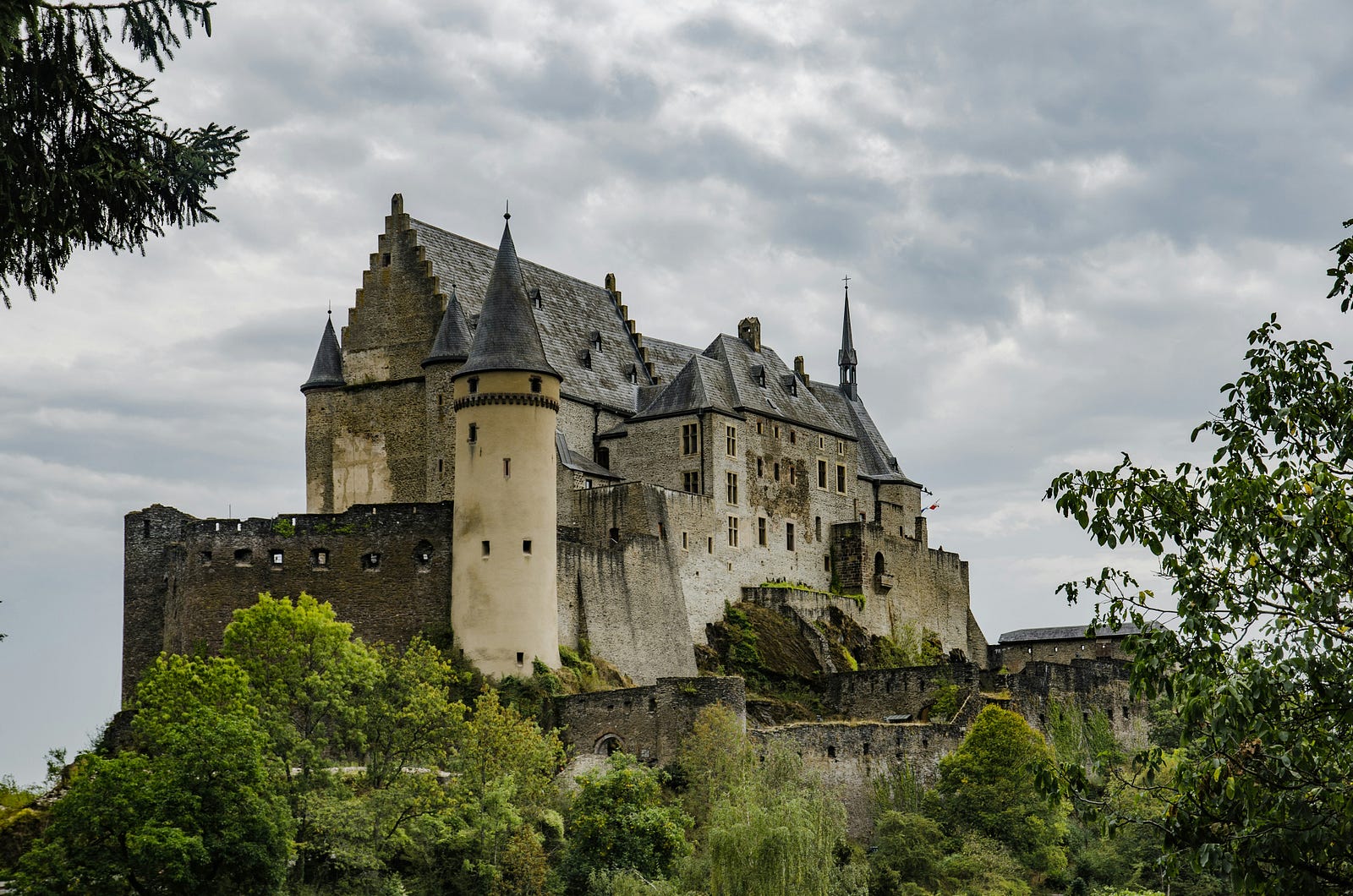
For many of us, our past is like a gigantic castle in which we have taken up official residence. It consists of countless corridors, staircases, halls, living spaces, secret rooms, dark rooms, love rooms, drama rooms, victim rooms, it-should-have-been-different rooms, blame rooms, painful rooms, trauma rooms, little-pleasures rooms, I-don’t-want-to-know rooms, why-me rooms, it’s-because-of-that rooms and I-pretend-it-doesn’t-exist rooms. We have made it our permanent home. We go from one room to the next. Tirelessly, we maintain the rooms that matter to us. The room that attracts us most at that moment and stirs up our emotions, we explore and study over and over again. Memories mingle with interpretations and inaccuracies, embellished with colourful details, so that a story is formed that hangs together for us. That story is not the truth. It is the truth of the person who created it. From that truth, we try to live in the NOW. An attempt that usually runs into obstacles, because we try to fit whatever happens in the NOW into our story about the past.
Living from the past is living on quicksand
Everything has its place. The NOW has its place. What has passed were moments in the NOW. What is yet to come are moments in the NOW. So in terms of time, there is only one moment, and that is the NOW, The Eternal Now. When you live in your castle of the past, you are in fact leaving the place of the NOW. You try to bring the past into the NOW. That doesn’t work, because the past doesn’t actually exist. Your first kiss fifteen years ago no longer exists. You can call up the memory of it, you can call up the emotion, but you can no longer call up the actual event. That you lost a sum of money through a wrong decision – that moment no longer exists. Again, you can become aware of memories and emotions, but you cannot undo the decision. Just as you cannot turn yesterday’s weather from rain into sunshine, or change the meal you ate yesterday into a different meal. You have lost a loved one to death. You can still feel that love, but you cannot undo their passing. Deep down, you know this. Against your better judgement, you are investing all your energy – in your thinking, feeling, acting, perceiving and in your identity – in an outcome that will never come about.
You are living on quicksand, on unstable ground, careful not to fall over. You have to make a great effort to keep your balance and move forward. Life in the NOW will show you this, with enormous patience, again and again, through the obstacles placed on your path. So that you can wake up in your life.
Your past is the foundation for the present
At the same time, your past can be a solid foundation for the NOW. Even though it doesn’t actually exist. I understand that this may confuse your brain, but the more you observe it, the more it will become reality – which in fact it already is. In the rooms of your castle, full of fascinating themes, life lessons lie hidden. Just as a quiz, a treasure hunt or a sporting achievement requires some effort to reach a satisfying result – without that effort, the fun soon wears off – so it is with life lessons. Although they are visible and present themselves again and again in a repeating loop, we miss them because, in our castle, we keep storming onto that roundabout and have to try once more to get out of the quicksand.
When we dare to look from the NOW at the themes, the thoughts, beliefs, pain and emotions that rise to the surface, something changes. Step by step, you learn something about yourself and about others. Step by step, the mystery of life reveals itself to you. You start choosing an exit from the roundabout. The road renews itself. You breathe more freely. Perspective becomes visible. What you have been through becomes valuable. Your experiences, combined with a greater inflow of love, bring you wisdom. What you went through in past moments of the NOW becomes a solid foundation for the present. The past is in its rightful place. It is a process that calls for real commitment and actions to be taken. The discipline for it lies with you.
Living from the past makes you unpredictable
It is not abnormal to be overwhelmed by emotions from the past. It is not abnormal to pay a visit to your second residence, your castle. Making it your permanent home, however, is no harmless matter. Old emotions rise to the surface and determine your present life. The past takes the reins and you are dragged along as if you were tied to the back of a bolting horse. You lose yourself on every level.
What’s more, you become unpredictable in your reactions. You fly off the handle in a situation that actually held nothing bad at all. You heap reproaches on someone because that person unconsciously reminds you of someone from your past. You are afraid of ‘all’ men/women because you once had a bad experience with someone. You project the unprocessed emotions you were left with indiscriminately onto the entire male/female population. You overprotect your children so that they won’t go through what you went through. You can add to these examples an endless number of situations you see around you.
How can someone else understand you if you react in the NOW from a situation in the past? How can you find your place in a group or a team if you are not here? How can you feel safe in yourself, let alone with someone else, if you are wandering around the dungeons of your castle?
At some point, you find yourself at the buffet of consequences
At some point, you notice that you don’t feel involved in life. What seems possible for others seems difficult or even impossible for you. Out of your longing for the past – for how it was, or how it should never have been – you miss out on the joy and abundance of life. The buffet of life serves up dishes made from recipes whose ingredients are your absence from the NOW.
The recipes taste of anger, pain, sorrow, illness, trauma, fears, rigidity, drama, misery, jealousy, frustration, incomprehension, victimhood, distractions, addiction and loss. Hard on your taste buds. You can no longer swallow a single bite. You can no longer digest it. It would give you indigestion.
Every now and then, you meet someone who says to you: ‘Do come out of your castle. Go on a journey in the NOW. Discover new colours, scents, sounds and flavours. Set off. There is still so much to discover. It is worth it.’ At that moment, you are faced with a choice. One you make. Or not.
‘Love lies at the bottom of the well. It cannot drown, but people do not like deep water.’
Djwhal Khul via Alice A. Bailey
Discipleship in the New Age 2
When you grow, the past changes
You can choose to keep your permanent address in your castle of the past because it feels safer. It is familiar. You know what to expect. Better to suffer than to embark on an unknown adventure whose outcome the passer-by could not tell you.
Or you can fill your rucksack with the life lessons you have learnt from the stories of your life, use them to your advantage and set off towards unknown roads. The path is strewn with pebbles, obstacles and detours, but the new experiences are a blessing for your lungs. They swell in and out once more to the rhythm of your joy in life. Your diaphragm relaxes. Your organs benefit from the fresh oxygen and put their best foot forward to carry out their task as well as they can. You meet other travellers on the path. They tell new stories and inspire you with descriptions of wondrous landscapes. Your world of thoughts and experiences breaks free from its immobility. Life flows again. You know once more that you are on your way and that everything has meaning.
Then, just like that, unexpectedly, memories of beautiful and funny moments come floating to the surface. You haven’t thought of them in years. For the first time, you remember again. It wasn’t all doom and gloom. There were many beautiful things too, but you had focused on everything you didn’t like. You have grown. Now your past suddenly seems to look different. Softer, gentler, more loving. How could you have forgotten that? You smile. You have entered the process.
Life knows only one direction
Life knows only one direction, and that is the direction of freedom. You look ahead from the NOW. The pushing force of the past and the pulling force of the future, neither of which exists, keep you firmly in the saddle of the NOW. Always moving towards the next NOW moment, which is always NOW. A feeling of freedom comes to meet you. You are on a journey through your life.
Basic steps to bring your focus to the NOW
Tip 1: Feeling your body helps you to live in the NOW
- Find a safe, comfortable place. Sit or lie down.
- Close your eyes and turn your attention to your body.
- Breathe in and out calmly. Follow the movement of your breath.
- Let yourself grow still inside.
- Look the emotions of your themes straight in the eye.
- Do this from the NOW moment.
- Name the facts you perceive. Don’t get caught up in the story.
- If you need guidance, I will gladly guide you. This is especially advisable at the beginning.
Tip 2: Explore the past through a family constellation and anchor yourself in the present
- If you feel you are ready for it, consider a family constellation.
- A family constellation is a therapeutic method in which you look systemically at your family and at the unconscious dynamics that influence your life.
- Make sure you are well guided in it. I will gladly guide you through it.
- Use the constellation to look at the past from the NOW, so that you can land firmly in the present.
Tip 3: Breathe your way to inner peace
- Learn different breathing techniques, such as abdominal breathing or the 4–7–8 technique.
- Start with daily exercises of a few minutes to get the hang of the breathing.
- Use your breath to work through difficult themes without needing words for them.
- Breathing cleanses, brings balance to your thinking, emotions and body, and opens up your spirituality.
- You can also let me guide you in this, but many breathing exercises you can do on your own.
Tip 4: Emergency stop in the NOW
- This exercise is intended to help someone calm down and ground themselves quickly during panic or anxiety.
- When you are panicking, name out loud all the facts you see around you, in as much detail as possible.
- Example: ‘I see a window divided into three parts. In the middle of the room there is a square rug in different colours. There is a painting hanging on the wall.’
- Example: There are four cars driving past, a blue one, …, an Opel, … There is a row of trees. Beneath them, a man is walking with a brown dog. The man is wearing a hat.
- This helps you to return quickly to the concrete NOW and reduces the panic.
- After this observation, take a few deep breaths to strengthen your sense of calm.


